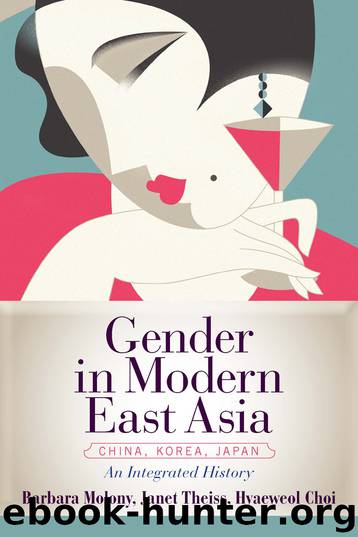
Gender in Modern East Asia by Barbara Molony
Author:Barbara Molony
Language: eng
Format: epub
ISBN: 9780813348766
Publisher: Westview Press
Published: 2016-03-01T05:00:00+00:00
7
Gender, Labor Markets, and the Economy in the Interwar Era
GLOBAL CONTEXT
World War I benefited the American economy, as it had the Japanese, because both nations were allied with the victors but were far from the battles that had ravaged much of Europe. While many American soldiers gave their lives in that war, U.S. soil was not touched, and the engines of American industry had been accelerated to supply the Allied forces. After the war, new consumer products entered the market, and many American workers, both men and women, who had enjoyed high levels of employment during the war, were able to buy those products. Not all families benefited equally, however, as new forms of racism separated African American and white workers. The first stage of the Great Migration of African Americans from the rural South to the industrial North, in response to the demand for workers during World War I, offered new opportunities to African Americans, but it also lit the fires of racist resistance against them in northern cities. As we will see in this chapter, not all working-class and middle-class employees were treated equally in any part of the world; gender, class, and ethnicity must be taken into consideration in analyzing labor and the economy in all countries.
In a number of industrial countries, the end of World War I also meant the return of soldiers and sailors. During the war, women had taken many of the jobs men left behind when they went to war, and in some cases, particularly in England, women were rewarded for their exceptional wartime contributions with expanded civil rights. But many working-class women in England were pushed out of work to make way for the returning servicemen. Upon losing their better-paid factory jobs, women were next hit with inequality in unemployment benefits. These benefits were denied to women if they did not agree to accept menial jobs such as domestic service, thereby reinforcing the gendered division of labor. If no such “women’s” jobs were available, women did receive unemployment benefits, but the British government paid women who managed to qualify for benefits much less than they paid men.
Middle-class women in England encountered problems different from those faced by their working-class sisters. On one hand, the Sex Disqualification Act of 1919 had opened the doors for British women to attend universities and develop careers as teachers, nurses, and other professionals. Civil service jobs were also opened to women, although most were in the lowest clerical grades. In the early 1930s, about one-third of women over fifteen worked outside the home, and about one-third of these were in domestic service. But 90 percent of married women did not work outside the home. This was not due entirely to choice: positions in teaching, the civil service, and various new professions usually had a “marriage bar” that required women to resign upon marriage. Thus, while working-class women were most adversely affected by sexism in the British workplace, middle-class women were also treated unequally. Similar kinds of gender
Download
This site does not store any files on its server. We only index and link to content provided by other sites. Please contact the content providers to delete copyright contents if any and email us, we'll remove relevant links or contents immediately.
| Anthropology | Archaeology |
| Philosophy | Politics & Government |
| Social Sciences | Sociology |
| Women's Studies |
The Secret History by Donna Tartt(19088)
The Social Justice Warrior Handbook by Lisa De Pasquale(12190)
Thirteen Reasons Why by Jay Asher(8910)
This Is How You Lose Her by Junot Diaz(6887)
Weapons of Math Destruction by Cathy O'Neil(6280)
Zero to One by Peter Thiel(5802)
Beartown by Fredrik Backman(5754)
The Myth of the Strong Leader by Archie Brown(5507)
The Fire Next Time by James Baldwin(5446)
How Democracies Die by Steven Levitsky & Daniel Ziblatt(5219)
Promise Me, Dad by Joe Biden(5153)
Stone's Rules by Roger Stone(5088)
A Higher Loyalty: Truth, Lies, and Leadership by James Comey(4964)
100 Deadly Skills by Clint Emerson(4925)
Rise and Kill First by Ronen Bergman(4789)
Secrecy World by Jake Bernstein(4753)
The David Icke Guide to the Global Conspiracy (and how to end it) by David Icke(4720)
The Farm by Tom Rob Smith(4513)
The Doomsday Machine by Daniel Ellsberg(4490)
